For Operations & IT Teams
Fix Operational Problems Before Implementation Chaos Begins
Internal initiatives always look simple at the start.
A new workflow. A dashboard. An approval process. An automation. A portal. A system change.
Then stakeholders join. Policies appear. Edge cases multiply. Existing systems create constraints. Requirements change. The “small internal tool” becomes a messy implementation problem.
BuildFlowIQ helps operations and IT teams clarify the initiative, validate assumptions, structure requirements, generate supporting artifacts, and prepare execution before delivery starts.
The Internal Initiative Problem
Internal work breaks when hidden complexity shows up late.
Operations and IT initiatives often fail because the real problem is discovered after execution begins.
The process has more exceptions than expected. Stakeholders disagree. Existing systems do not support the workflow. Approvals are unclear. Data ownership is messy. Teams build around assumptions instead of validated context.
BFIQ helps expose these issues before teams commit time, budget, and delivery capacity.
The process is not really understood
Teams automate a broken workflow instead of clarifying what should actually happen.
System constraints arrive late
Integrations, permissions, data quality, and existing tools create delivery risk.
Stakeholders are misaligned
Operations, IT, finance, HR, compliance, and business teams often expect different outcomes.
Rollout is treated as an afterthought
Training, adoption, governance, communication, and support are planned too late. Visual Cue
Requirements keep changing
What starts as a simple request becomes a moving target once edge cases appear.
Operational Discovery
Clarify the real workflow before planning the solution.
BFIQ helps convert raw client input into a structured Discovery Summary.
Instead of treating discovery as a one-time meeting, the platform captures the client’s problem, goals, constraints, stakeholders, risks, outcomes, and solution direction in a format that can feed every downstream deliverable.
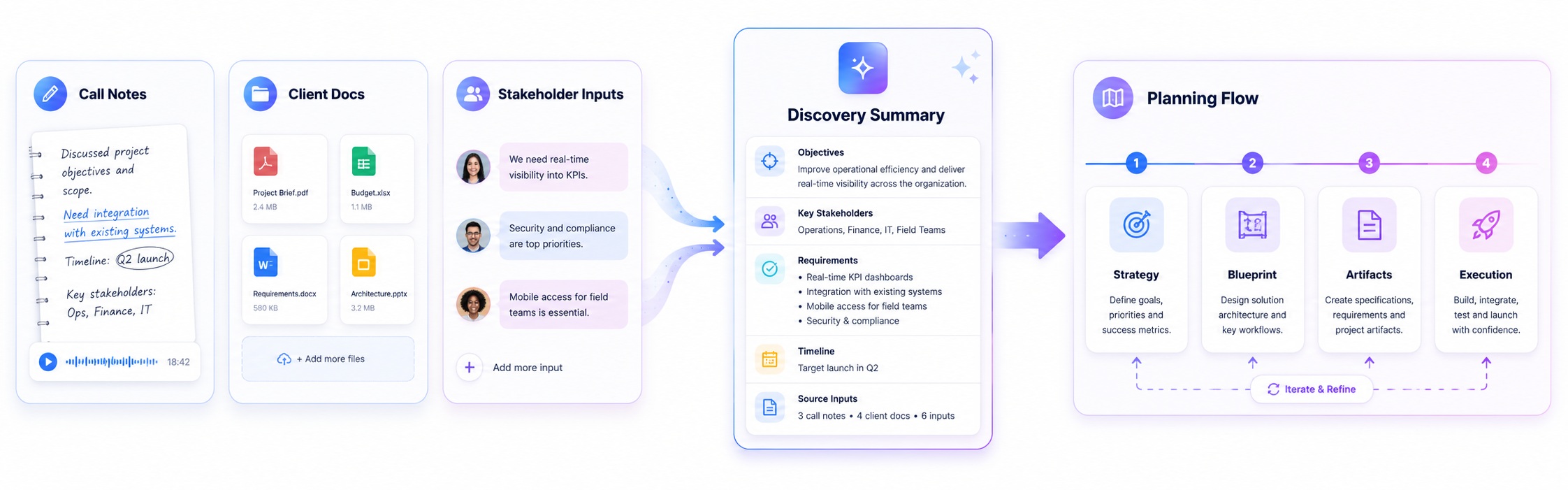
Clarify the real workflow before planning the solution.
Operational Discovery
BuildFlowIQ helps teams capture the operational problem before jumping into tools, automation, or implementation.
Discovery asks the right questions around current process, users, departments, pain points, approvals, constraints, success metrics, dependencies, and expected outcomes.
The result is a structured initiative foundation that operations, IT, and business teams can review together.
What It Helps With
- Define the internal problem clearly
- Capture departments, users, and stakeholder groups
- Understand workflow steps and pain points
- Identify constraints, approvals, and dependencies
- Define what success should look like
- Create reusable context for planning and execution
Output: Internal Initiative Discovery Summary
Turn workflow clarity into structured requirements.
ValidationIQ for Operations
Internal initiatives are full of assumptions.
Users will adopt the new workflow. The data is available. The approval chain is clear. The system can integrate. The process is the same across teams. The rollout will be easy.
ValidationIQ helps identify which assumptions are supported, which are risky, and which need more evidence before deeper planning begins.
What It Helps With
- Separate known facts from assumptions
- Surface contradictions between departments
- Identify missing evidence
- Flag adoption, system, policy, and rollout risks
- Recommend validation actions
- Improve readiness before requirements are created
Output: Operational Validation Context
ValidationIQ helps teams avoid building internal tools on untested operational assumptions.
Make the handoff as strong as the strategy.
Blueprint for Operations
Once the initiative is clarified and validated, BFIQ helps convert the operational context into a structured Blueprint.
The Blueprint can define workflows, user journeys, functional requirements, non-functional requirements, integrations, roles, permissions, risks, priorities, and acceptance expectations.
This gives IT and delivery teams clearer input before implementation starts.
What It Helps With
- Map current and future workflows
- Define user roles and responsibilities
- Capture functional and non-functional requirements
- Identify integrations and data dependencies
- Document risks and acceptance expectations
- Support review before development or vendor handoff
Output: Operational Blueprint
Blueprint turns internal complexity into execution-ready requirements.
Create the documents that make internal change easier to launch.
Operational Artifacts
Internal initiatives do not end with requirements.
Teams also need rollout plans, governance checklists, stakeholder FAQs, operating guides, support notes, measurement plans, training outlines, and risk registers.
BFIQ helps generate these supporting artifacts from the same approved planning context, so the rollout is not disconnected from the original initiative.
Example Artifacts
- Rollout Plan
- Governance Checklist
- Operating Guide
- Stakeholder FAQ
- Measurement Plan
- Support Readiness Checklist
- Change Communication Plan
Output: Operational Artifact Pack
Artifacts help internal initiatives move from approved plan to usable rollout.
Turn the approved plan into workstreams, milestones, and dependencies.
ProjectIQ for Internal Delivery
Operations and IT teams need more than a requirements document.
ProjectIQ converts approved planning context into execution domains, workstreams, milestones, dependencies, execution items, and delivery intelligence.
This helps teams see what needs to happen, who is impacted, what depends on what, and where execution risk may appear.
What It Helps With
- Create implementation workstreams
- Identify milestones and dependencies
- Organize delivery items
- Preserve context behind the work
- Support handoff to internal teams or vendors
- Prepare execution structure for review
Output: ProjectIQ Execution Structure
ProjectIQ keeps internal delivery connected to the original business problem.
//Clearer workflows. Stronger requirements. Cleaner rollout.
Do not automate confusion.
Before your team builds an internal tool, redesigns a workflow, starts an automation, or briefs a vendor, make sure the initiative is clear enough to execute.
BuildFlowIQ helps operations and IT teams clarify the problem, validate assumptions, create requirements, generate rollout artifacts, and prepare execution planning.