
BuildFlowIQ | AI Initiative Planning & Execution Intelligence Platform
- Home
- AI Requirements Generator: What It Should Actually Do
AI Requirements Generator: What It Should Actually Do
Introduction
AI can generate requirements quickly. That is both useful and dangerous. A model can turn a vague product idea into a convincing list of features in seconds. The output may look professional, but the real question is whether the requirements are grounded in the right context.
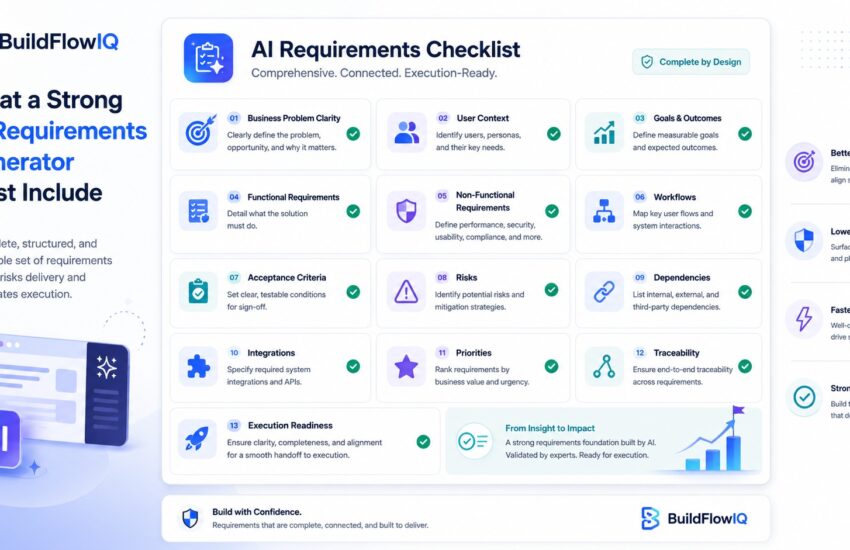
A serious AI requirements generator should do more than produce polished text. It should help clarify the problem, validate assumptions, preserve research context, connect strategy to requirements, identify risks, define workflows, and prepare execution. If it does not do those things, it may simply automate weak planning.
The danger of fast requirements
Requirements feel concrete. That is why teams like them. Once requirements exist, the initiative appears to have structure. But if those requirements are generated from incomplete input, they can create false confidence. The team may start estimating, designing, or building based on a document that never challenged the assumptions behind the idea.
Fast requirements are valuable only when the foundation is strong. Otherwise, the organization gets a feature list that looks more mature than the thinking behind it. This is how AI can increase planning risk instead of reducing it.
It should ask before it writes
The first job of an AI requirements generator should be to ask better questions. What problem are we solving? Who is affected? What outcome matters? What constraints exist? What is in scope? What is out of scope? What assumptions are we making? What evidence supports the direction? What risks should shape the plan?
A requirements tool that jumps directly to output may be convenient, but it is not reliable for serious work. Guided discovery is not a luxury. It is the input quality layer. Without it, requirements generation becomes a guess.
It should separate assumptions from facts
Requirements often contain hidden assumptions. For example, ‘The system shall allow users to configure onboarding flows’ assumes users need configuration, understand the workflow, and have a reason to change defaults. ‘The dashboard shall show real-time data’ assumes real-time visibility is valuable, technically feasible, and worth the cost. These assumptions should be visible.
A good AI requirements generator should label assumptions, evidence gaps, and risky claims before turning them into requirements. It should help users understand which requirements are supported and which require further validation.
It should preserve strategy
Requirements should not be created in isolation. They should follow strategic direction. If the chosen strategy is to launch a narrow MVP for one user segment, the requirements should reflect that constraint. If the strategic path is operational efficiency, requirements should prioritize workflow clarity and measurable process outcomes. If the strategy is differentiation, requirements should support the distinctive value proposition.
Without strategy, requirements become a negotiation between opinions. With strategy, they become an execution expression of a chosen direction.
It should include workflows and non-functional needs
Many generated requirements lists focus heavily on functional features. Serious planning also requires workflows, user journeys, roles, permissions, integrations, data needs, performance expectations, security considerations, usability expectations, compliance constraints, acceptance criteria, and operational support requirements.
This is especially important for internal tools, SaaS products, enterprise systems, HR policy changes, and operations initiatives. The visible feature is only one part of execution. The hidden non-functional and workflow requirements often create the most expensive surprises.
It should create traceability
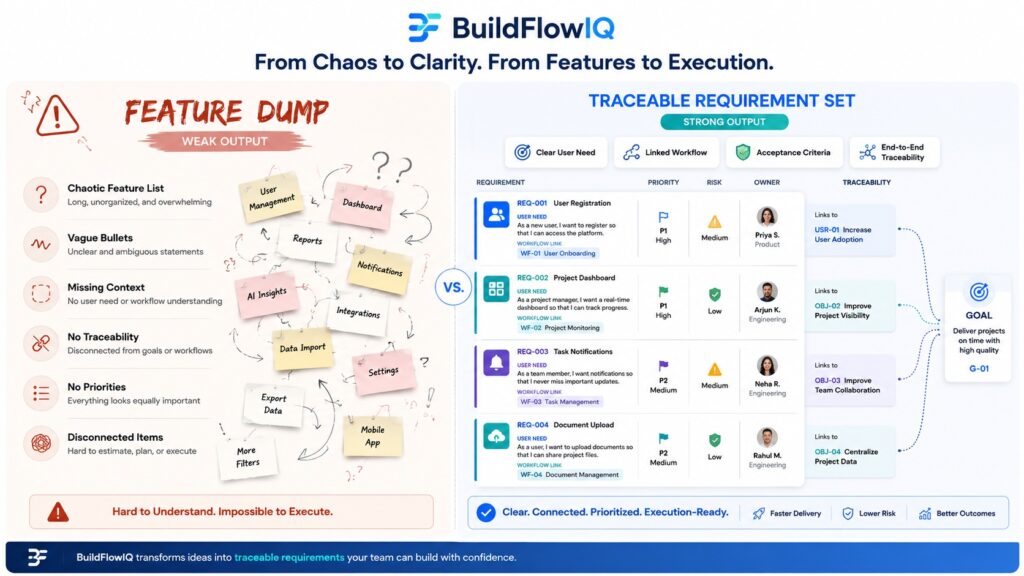
Traceability connects requirements to upstream decisions. A requirement should have a reason. It may connect to a validated user pain, a strategic recommendation, a risk mitigation action, an operational constraint, or a stakeholder outcome. When requirements are traceable, teams can review them intelligently.
This helps during scope changes. If a requirement is challenged, the team can see why it exists. If the strategic path changes, related requirements can be adjusted. Traceability turns requirements from static text into living planning logic.
It should support review and regeneration
AI output should not be accepted blindly. A good generator should support review, quality checks, repair, regeneration, versioning, and approval. Requirements are high-impact planning assets. They should be inspected before they become source context for artifacts or execution planning.
BuildFlowIQ treats requirements generation through the Blueprint stage. The Blueprint is generated after Discovery, ValidationIQ, ResearchIQ, SimulationIQ, and Strategic Recommendation. This means requirements are created from structured initiative intelligence, not from a single prompt.
What to look for in a tool
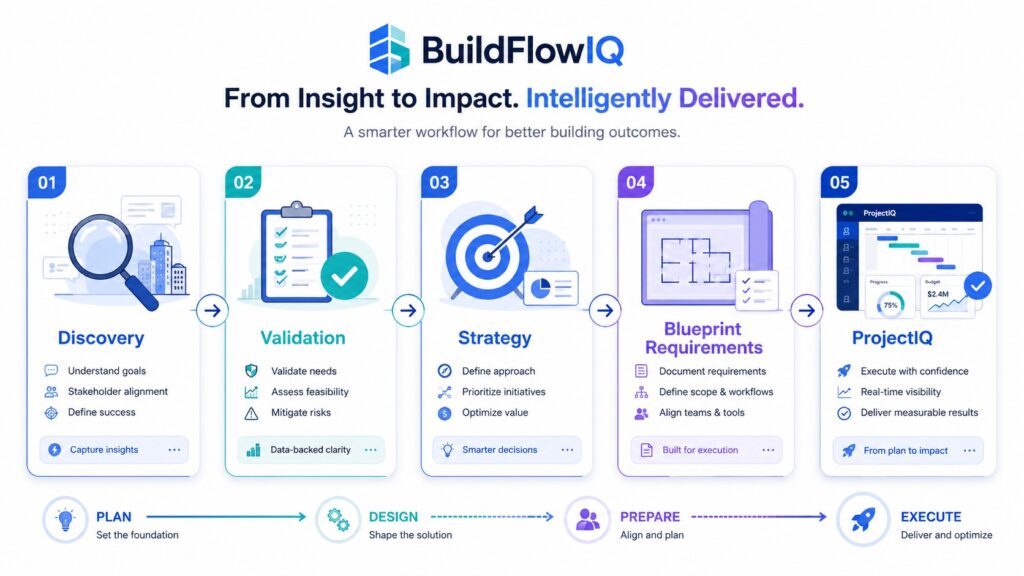
When evaluating an AI requirements generator, ask these questions: Does it guide discovery? Does it validate assumptions? Does it connect requirements to strategy? Does it include workflows and non-functional needs? Does it handle risks and acceptance expectations? Does it preserve context across stages? Does it prepare execution handoff? Does it support human review?
If the tool only writes a feature list, it may save time in the short term while creating confusion later. The right tool should help teams produce requirements that are not only faster, but stronger.
Conclusion
An AI requirements generator should not simply write what the user asks for. It should help the user discover whether the request is clear, validated, strategic, and ready for execution. It should turn intelligence into requirements, not assumptions into tasks.
The best output is not the longest requirements document. It is the clearest planning foundation. That is the standard BuildFlowIQ applies through Blueprint and ProjectIQ.
How to use this idea in a real team
For a real team, AI requirements generator should never live only as a theory. It should change how the team runs the next initiative review. Before approving budget, scope, or delivery capacity, leaders should ask whether the initiative has enough clarity to move forward. The answer should come from visible planning evidence, not from confidence alone.
A useful review should include the initiative owner, at least one decision maker, one delivery representative, and someone close to the user or operational problem. This prevents the plan from becoming a leadership-only document or a delivery-only task list. Strong initiative planning connects business logic, user reality, operational constraints, and execution detail.
The team should also decide what kind of decision is being made. Sometimes the right decision is to continue. Sometimes it is to revise the scope, pause for more evidence, or reject the initiative. Good planning does not automatically push every idea forward. It helps the organization commit only when the idea deserves deeper investment.
What good output should look like
A good output should be specific enough to challenge. If a statement is so broad that everyone can agree with it, it may not be useful. For example, ‘improve user experience’ is weaker than a defined problem, named audience, measurable outcome, and visible constraint. The stronger the output, the easier it is for stakeholders to review it honestly.
Good output should also show its reasoning. Teams should be able to see which assumptions are still open, which evidence supports the direction, which risks matter, and which decisions shaped the plan. This is where traceability becomes practical. It turns planning from polished text into a decision chain that can be inspected.
Finally, good output should be usable downstream. A discovery summary should support validation. Validation should influence research and scenarios. Strategy should shape the Blueprint. The Blueprint should support artifacts and ProjectIQ. If an output cannot strengthen the next stage, it is probably not structured enough.
Questions to ask before moving forward
Before the initiative moves deeper into planning, teams should ask: What is the real problem? Who is affected? What outcome matters? What must be true for this to work? What evidence do we already have? What is still assumed? What could make execution fail? What should be validated before we spend more?
For product teams, the questions may focus on user pain, adoption, differentiation, MVP scope, integration complexity, and willingness to pay. For operations teams, the questions may focus on current workflow, stakeholder alignment, approvals, data quality, policy constraints, and rollout readiness. For consultants, the questions may focus on client assumptions, decision logic, deliverables, and handoff strength.
These questions are simple, but many teams skip them because the visible work feels more urgent. BuildFlowIQ is designed to bring these questions into a controlled flow so the team does not depend on memory, scattered documents, or one person’s ability to write a perfect prompt.
Common mistakes to avoid
The first mistake is starting with the final document. Teams often ask AI to generate a business plan, PRD, roadmap, or execution plan before the underlying initiative is clear. This produces output, but not necessarily intelligence. A better approach is to mature the initiative stage by stage.
The second mistake is treating AI output as approval. AI can draft, structure, compare, and suggest, but humans still need to review. This is especially important for financial, legal, HR, policy, compliance, technical, and customer-impacting decisions. The platform can reduce blind spots, but it cannot replace accountability.
The third mistake is losing context between tools. A team may use chat for research, documents for requirements, spreadsheets for risks, slides for strategy, and project tools for tasks. When the context breaks, every handoff becomes weaker. The value of an initiative intelligence platform is that the chain stays connected.
How BuildFlowIQ supports the workflow
BuildFlowIQ supports this workflow through a lifecycle designed for serious planning: Initiative -> Discovery -> ValidationIQ -> ResearchIQ -> SimulationIQ -> Strategic Recommendation -> Blueprint -> Artifacts -> ProjectIQ. The point of the lifecycle is not to add complexity. It is to prevent a weak idea from becoming a polished plan too early.
Discovery captures the initiative truth. ValidationIQ checks assumptions, risks, contradictions, and evidence gaps. ResearchIQ organizes intelligence. SimulationIQ explores possible paths. Strategic Recommendation chooses direction. Blueprint converts decisions into structured planning detail. Artifacts create supporting deliverables. ProjectIQ prepares execution structure.
Where this becomes valuable
The practical value of AI requirements generator is highest when the initiative has real cost, uncertainty, or stakeholder complexity. A casual idea can be handled with a note. A serious initiative needs a stronger path because the cost of being wrong is not just a bad document; it is wasted execution capacity.
This applies to product launches, internal tools, client engagements, marketing initiatives, HR or policy rollouts, operations improvements, and AI transformation work. The surface details change, but the planning problem is similar: teams need to clarify the initiative, test assumptions, connect decisions, and prepare execution with enough context.
Review checklist for the reader
Before acting on the ideas in this article, the reader should pick one current initiative and ask whether the current plan is inspectable. Can a new stakeholder understand the problem, assumptions, evidence, strategy, requirements, risks, artifacts, and execution path without chasing five different documents? If not, the planning chain is weak.
The reader should also check whether the next action is obvious. A strong plan should not end with ‘we need to discuss more.’ It should show whether the team should continue, revise, pause, validate, research, blueprint, generate artifacts, or prepare execution. That is where planning becomes useful instead of decorative.
