
BuildFlowIQ | AI Initiative Planning & Execution Intelligence Platform
- Home
- Why Business Initiatives Fail Before Execution Starts
Why Business Initiatives Fail Before Execution Starts
Introduction
When a business initiative fails, people usually blame execution. The team missed deadlines. The vendor underperformed. The scope changed. The budget was too small. The market was harder than expected. These explanations may be partly true, but they often describe symptoms rather than the original cause.
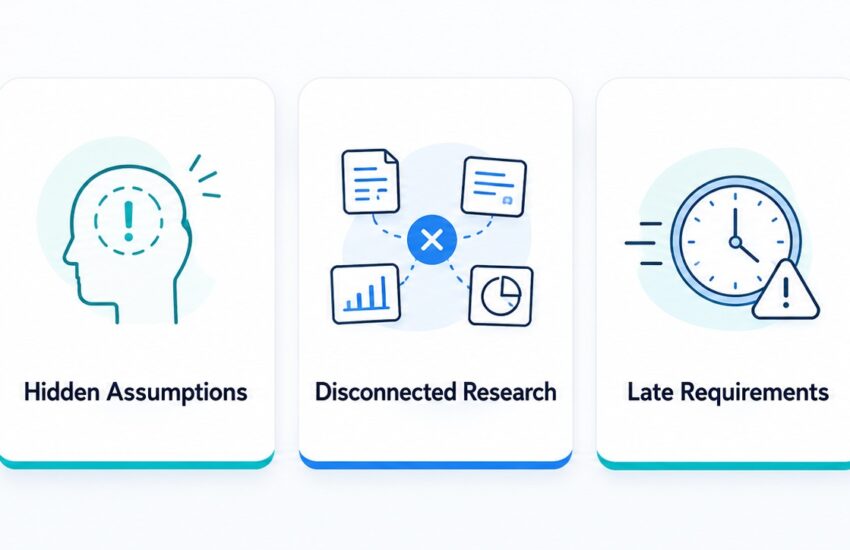
Many initiatives fail before execution starts. The damage begins when teams approve unclear ideas, treat assumptions as facts, skip validation, write vague requirements, disconnect research from strategy, and hand off plans without enough context. Execution only reveals the weakness that planning created earlier.
The first failure is unclear intent
A vague initiative can survive surprisingly long inside an organization. It can appear in a leadership meeting, become a slide, receive a budget range, and move into execution before anyone agrees on the real problem. Different stakeholders may support the initiative for different reasons. One person sees growth. Another sees efficiency. Another sees compliance. Another sees customer experience. All of them say yes, but they are not saying yes to the same thing.
This unclear intent becomes expensive later. Requirements become unstable because the team is still discovering what the initiative actually means. Priorities change because the original goal was not specific enough. Delivery teams ask for decisions that should have been made before work began.
The second failure is assumption blindness
Every initiative contains assumptions. Users will adopt the change. Customers will pay. Employees will follow the process. Systems can integrate. Data will be available. Stakeholders will align. The timeline is realistic. The team has capacity. These assumptions may be reasonable, but reasonable does not mean validated.
The problem is that assumptions often enter plans disguised as facts. A confident stakeholder says something in a meeting, and the team writes it into the plan. A founder believes a pain point is urgent, so the feature becomes mandatory. A department claims a process is consistent, but every branch handles it differently. When these assumptions are not surfaced early, execution becomes the testing ground.
The third failure is weak evidence
Some initiatives are backed by evidence. Others are backed by anecdotes. Many are backed by a mixture of both. Teams frequently fail to label the difference. Research becomes a folder of useful but disconnected information. Competitive analysis sits in one document. Customer conversations sit in another. Operational data lives in spreadsheets. The final strategy may mention evidence, but the evidence rarely remains traceable to decisions.
A stronger planning process separates known facts, assumptions, inferences, unknowns, and implications. It does not demand perfect proof for every decision, because business rarely works that way. But it does require honesty about confidence. Knowing what you do not know is a planning advantage.
The fourth failure is strategy after scope
Too many teams write requirements before choosing a strategic path. They move from idea to feature list because features feel concrete. But features without strategy become clutter. The team starts asking what to build before deciding how to win, what to avoid, which audience matters first, what tradeoffs are acceptable, and what success should look like.
This is why initiatives become bloated. Every stakeholder request feels important when there is no clear strategic filter. The minimum viable product stops being minimum. The internal tool tries to solve every edge case. The campaign attempts to serve every audience. The policy rollout becomes overloaded with messages. Strategy must constrain the plan before requirements expand.
The fifth failure is late requirements
Requirements are often created after momentum has already formed. A team has agreed to build. Vendors have been contacted. Designers have started exploring screens. Engineers are asking for tickets. Only then does the organization realize the workflows, roles, integrations, constraints, risks, and acceptance expectations are incomplete.
Late requirements create rework. They also create political friction because changes now feel like delays rather than planning corrections. A better process creates a structured Blueprint before execution begins. That Blueprint should connect strategy, workflows, requirements, risks, priorities, integrations, traceability, and acceptance criteria.
The sixth failure is broken handoff
Even when planning documents exist, handoff can break. A delivery team receives a deck or a backlog without the original reasoning. They see tasks but not assumptions. They see milestones but not risks. They see requirements but not the strategic tradeoffs that shaped them. When context is missing, teams make local decisions that can drift from the initiative intent.
A strong handoff preserves the why behind the work. It turns approved planning context into execution domains, workstreams, milestones, dependencies, and execution items. The execution structure should not be disconnected from Discovery, ValidationIQ, ResearchIQ, SimulationIQ, Strategy, Blueprint, and Artifacts.
How to prevent early failure
The prevention method is not more meetings. It is a better planning chain. Start by capturing raw intent. Complete guided discovery. Run validation to surface assumptions and evidence gaps. Build research intelligence. Explore scenarios before commitment. Choose a strategic recommendation. Create a Blueprint. Generate the supporting artifacts. Prepare execution with ProjectIQ.
This approach makes the initiative stronger before execution begins. It also gives leaders a better approval mechanism. Instead of asking, ‘Do we like this idea?’ they can ask, ‘Is the initiative clear, validated, strategically sound, sufficiently planned, and execution-ready?’
Conclusion
Business initiatives do not usually fail in one dramatic moment. They weaken quietly through skipped questions, untested assumptions, vague decisions, and disconnected handoffs. Execution makes those weaknesses visible, but planning created them.
The better principle is simple: do not execute a weak idea beautifully. Clarify it, validate it, research it, simulate it, choose the path, create the Blueprint, generate the artifacts, and prepare execution with context. That is how teams reduce preventable failure before work begins.
How to use this idea in a real team

For a real team, why business initiatives fail should never live only as a theory. It should change how the team runs the next initiative review. Before approving budget, scope, or delivery capacity, leaders should ask whether the initiative has enough clarity to move forward. The answer should come from visible planning evidence, not from confidence alone.
A useful review should include the initiative owner, at least one decision maker, one delivery representative, and someone close to the user or operational problem. This prevents the plan from becoming a leadership-only document or a delivery-only task list. Strong initiative planning connects business logic, user reality, operational constraints, and execution detail.
The team should also decide what kind of decision is being made. Sometimes the right decision is to continue. Sometimes it is to revise the scope, pause for more evidence, or reject the initiative. Good planning does not automatically push every idea forward. It helps the organization commit only when the idea deserves deeper investment.
What good output should look like
A good output should be specific enough to challenge. If a statement is so broad that everyone can agree with it, it may not be useful. For example, ‘improve user experience’ is weaker than a defined problem, named audience, measurable outcome, and visible constraint. The stronger the output, the easier it is for stakeholders to review it honestly.
Good output should also show its reasoning. Teams should be able to see which assumptions are still open, which evidence supports the direction, which risks matter, and which decisions shaped the plan. This is where traceability becomes practical. It turns planning from polished text into a decision chain that can be inspected.
Finally, good output should be usable downstream. A discovery summary should support validation. Validation should influence research and scenarios. Strategy should shape the Blueprint. The Blueprint should support artifacts and ProjectIQ. If an output cannot strengthen the next stage, it is probably not structured enough.
Questions to ask before moving forward
Before the initiative moves deeper into planning, teams should ask: What is the real problem? Who is affected? What outcome matters? What must be true for this to work? What evidence do we already have? What is still assumed? What could make execution fail? What should be validated before we spend more?
For product teams, the questions may focus on user pain, adoption, differentiation, MVP scope, integration complexity, and willingness to pay. For operations teams, the questions may focus on current workflow, stakeholder alignment, approvals, data quality, policy constraints, and rollout readiness. For consultants, the questions may focus on client assumptions, decision logic, deliverables, and handoff strength.
These questions are simple, but many teams skip them because the visible work feels more urgent. BuildFlowIQ is designed to bring these questions into a controlled flow so the team does not depend on memory, scattered documents, or one person’s ability to write a perfect prompt.
Common mistakes to avoid
The first mistake is starting with the final document. Teams often ask AI to generate a business plan, PRD, roadmap, or execution plan before the underlying initiative is clear. This produces output, but not necessarily intelligence. A better approach is to mature the initiative stage by stage.
The second mistake is treating AI output as approval. AI can draft, structure, compare, and suggest, but humans still need to review. This is especially important for financial, legal, HR, policy, compliance, technical, and customer-impacting decisions. The platform can reduce blind spots, but it cannot replace accountability.
The third mistake is losing context between tools. A team may use chat for research, documents for requirements, spreadsheets for risks, slides for strategy, and project tools for tasks. When the context breaks, every handoff becomes weaker. The value of an initiative intelligence platform is that the chain stays connected.
How BuildFlowIQ supports the workflow
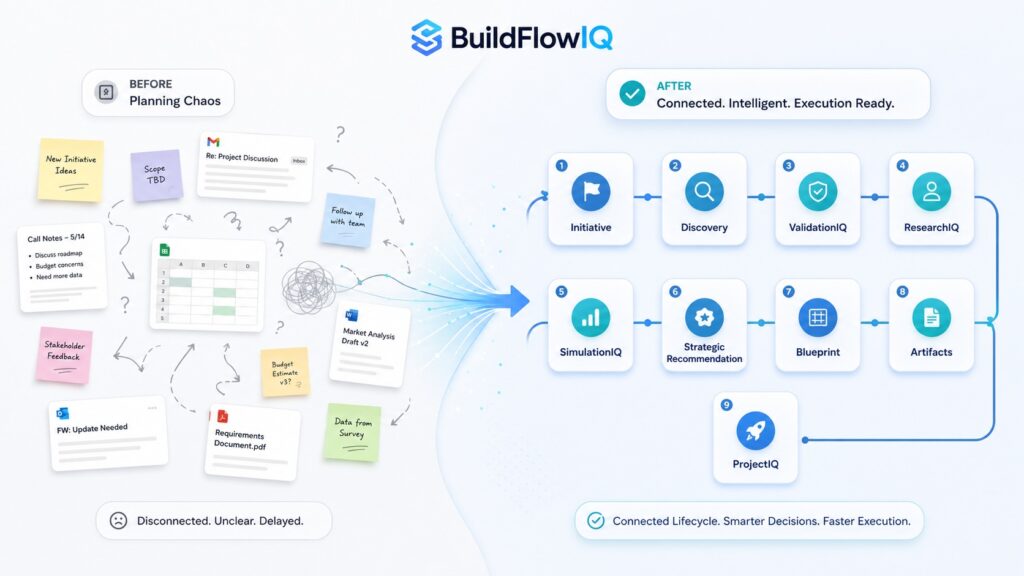
BuildFlowIQ supports this workflow through a lifecycle designed for serious planning: Initiative -> Discovery -> ValidationIQ -> ResearchIQ -> SimulationIQ -> Strategic Recommendation -> Blueprint -> Artifacts -> ProjectIQ. The point of the lifecycle is not to add complexity. It is to prevent a weak idea from becoming a polished plan too early.
Discovery captures the initiative truth. ValidationIQ checks assumptions, risks, contradictions, and evidence gaps. ResearchIQ organizes intelligence. SimulationIQ explores possible paths. Strategic Recommendation chooses direction. Blueprint converts decisions into structured planning detail. Artifacts create supporting deliverables. ProjectIQ prepares execution structure.
Where this becomes valuable
The practical value of why business initiatives fail is highest when the initiative has real cost, uncertainty, or stakeholder complexity. A casual idea can be handled with a note. A serious initiative needs a stronger path because the cost of being wrong is not just a bad document; it is wasted execution capacity.
This applies to product launches, internal tools, client engagements, marketing initiatives, HR or policy rollouts, operations improvements, and AI transformation work. The surface details change, but the planning problem is similar: teams need to clarify the initiative, test assumptions, connect decisions, and prepare execution with enough context.
Review checklist for the reader
Before acting on the ideas in this article, the reader should pick one current initiative and ask whether the current plan is inspectable. Can a new stakeholder understand the problem, assumptions, evidence, strategy, requirements, risks, artifacts, and execution path without chasing five different documents? If not, the planning chain is weak.
The reader should also check whether the next action is obvious. A strong plan should not end with ‘we need to discuss more.’ It should show whether the team should continue, revise, pause, validate, research, blueprint, generate artifacts, or prepare execution. That is where planning becomes useful instead of decorative.
