Reduce Blind Spots
Expose assumptions, risks, contradictions, and missing evidence before they become delivery problems.
BuildFlowIQ | AI Initiative Planning & Execution Intelligence Platform

Most business ideas do not fail because teams cannot work hard enough. They fail because the planning chain breaks too early.
The first idea is vague. Discovery is incomplete. Assumptions are treated like facts. Research is disconnected from requirements. Strategy becomes a guess. Documents are created in isolation. Execution starts before the initiative is ready.
BuildFlowIQ gives every initiative a connected AI-powered lifecycle.
From raw intent to Discovery, ValidationIQ, ResearchIQ, SimulationIQ, Strategic Recommendation, Blueprint, Artifacts, and ProjectIQ, BFIQ helps teams turn unclear ideas into structured, reviewable, traceable, and execution-ready plans.
This is not loose prompting. This is initiative intelligence from idea to execution.
BuildFlowIQ is built around one simple belief: serious initiatives need continuity.
Every stage should strengthen the next. Discovery should feed validation. Validation should guide research. Research should inform scenarios. Scenarios should shape strategy. Strategy should constrain the Blueprint. The Blueprint should drive artifacts. Artifacts and approved planning context should prepare ProjectIQ execution planning.
That is the BFIQ lifecycle.
Capture the initiative before planning becomes scattered.
Expose assumptions, contradictions, evidence gaps, and risks early.
Turn context into evidence-aware initiative intelligence.
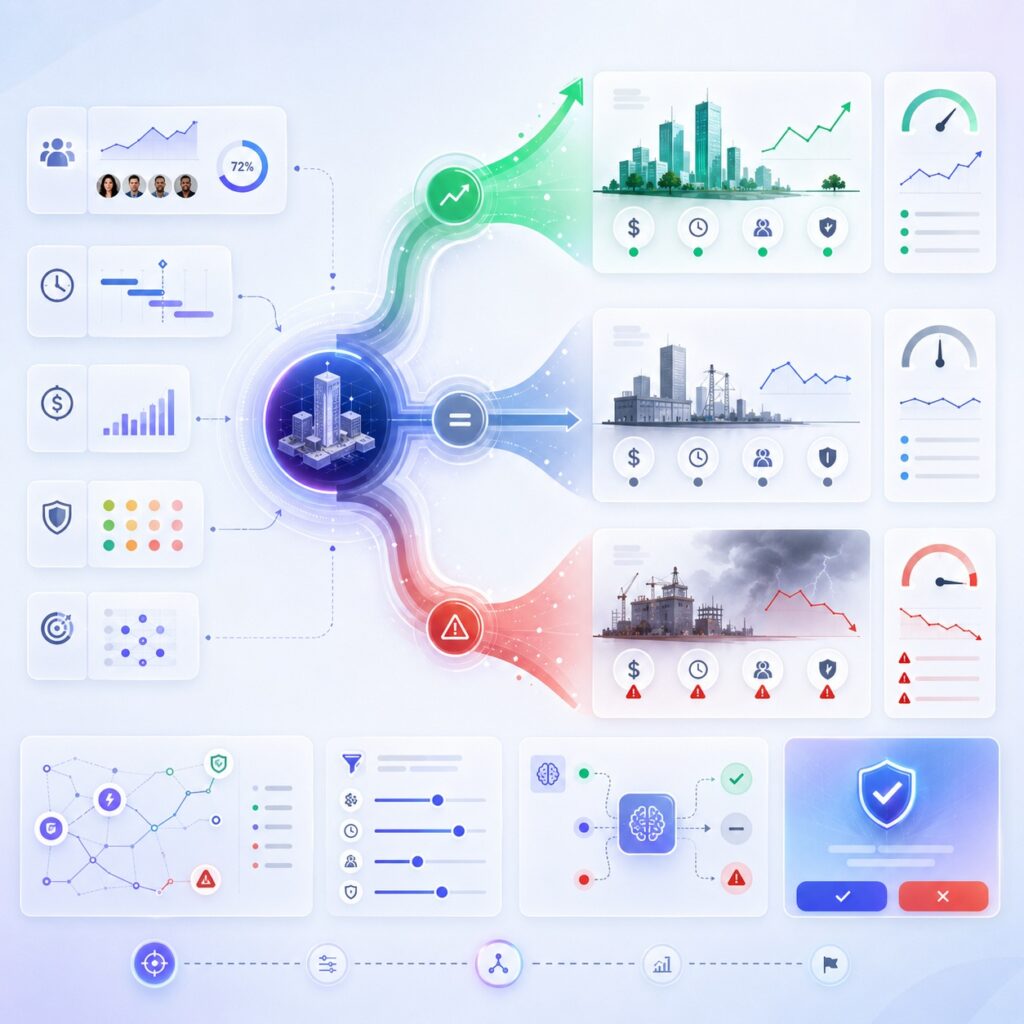
Explore possible paths before resources are committed.
Choose the strategic direction with tradeoffs visible.
Convert decisions into structured requirements and planning detail.
Generate supporting artifacts tied to the initiative.
Turn approved planning into workstreams, milestones, dependencies, and execution items.
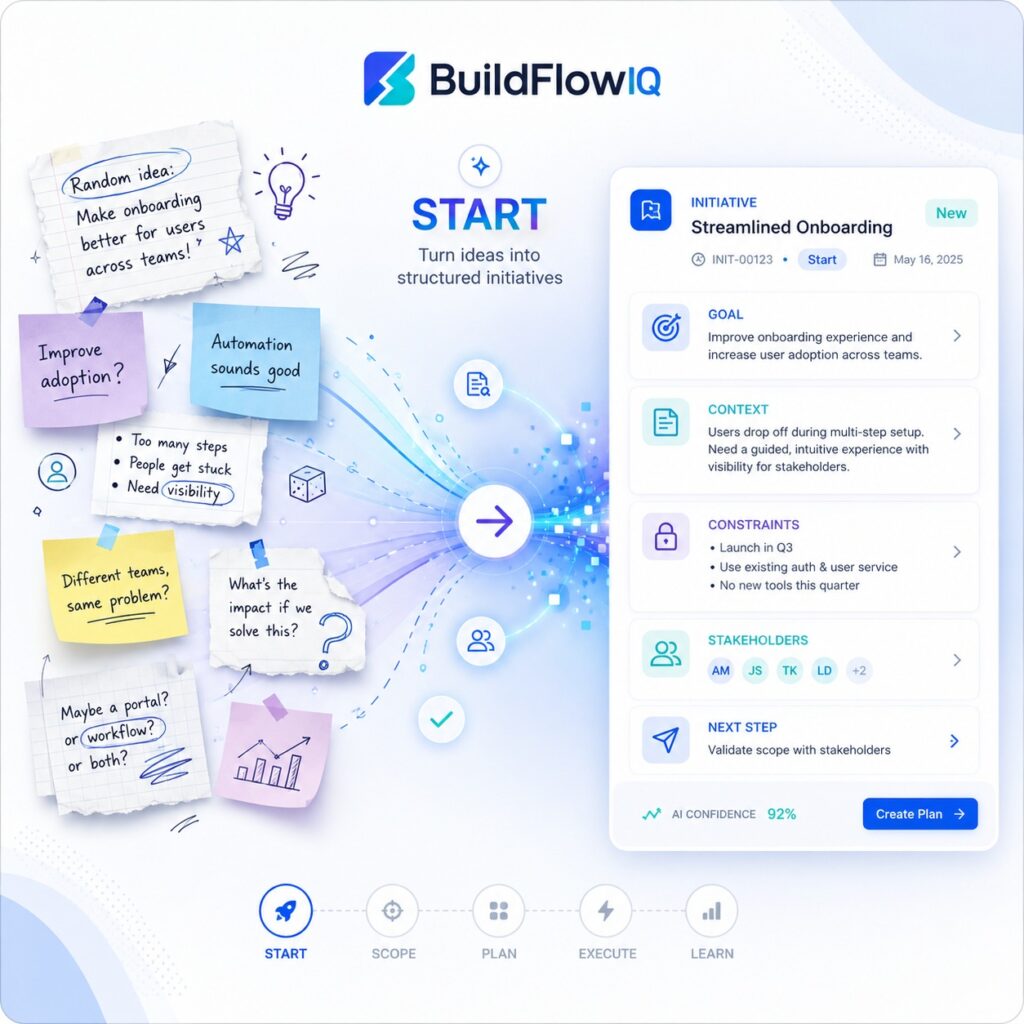
Every initiative starts somewhere: a founder’s idea, a client request, an internal business problem, a product opportunity, a policy change, an automation need, or a transformation goal.
BuildFlowIQ does not force you to start with a perfect brief.
You begin with the raw initiative: what you are thinking, what problem you want to solve, who it may affect, what outcome you want, and what constraints already matter.
BFIQ captures that early intent and prepares it for deeper discovery.
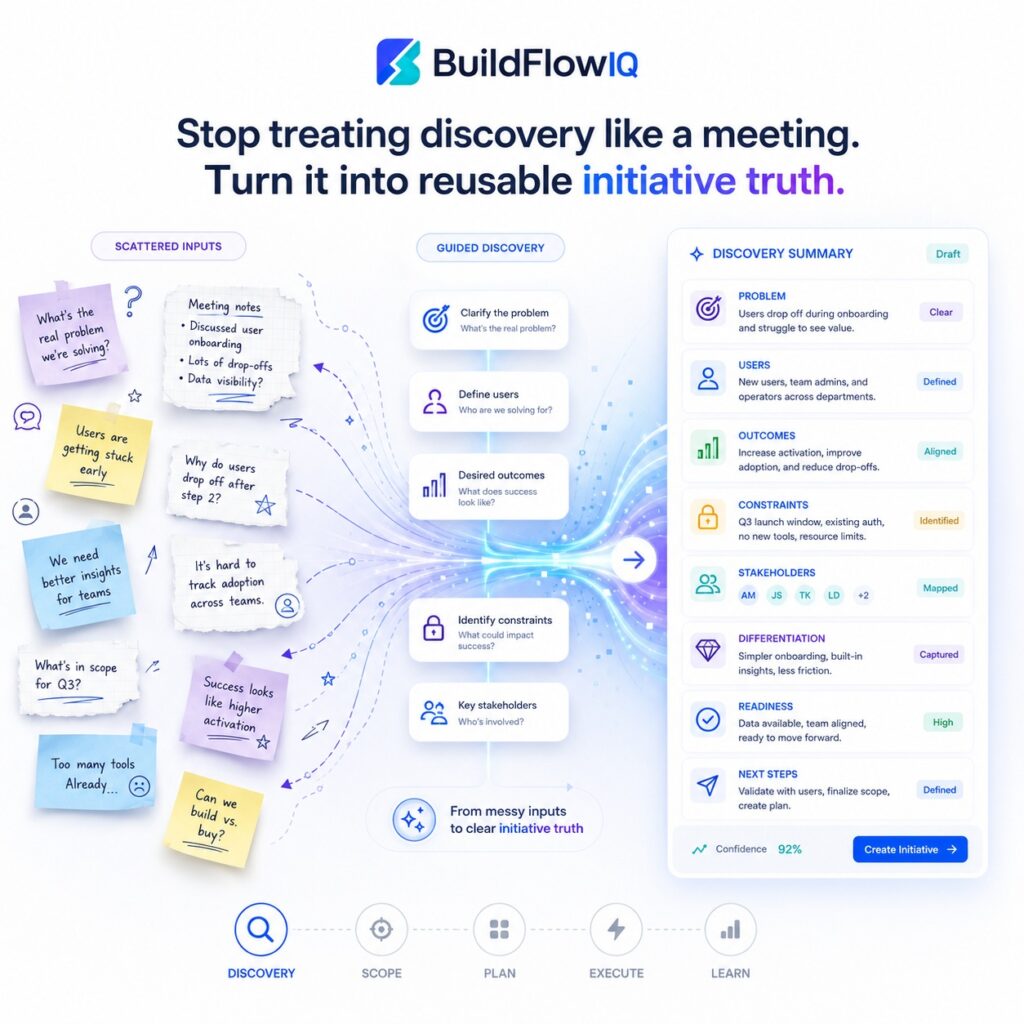
Most execution problems begin when teams skip discovery or leave it trapped in scattered notes.
Discovery helps teams define the initiative before deeper planning begins. It asks guided questions across problem clarity, users, outcomes, constraints, solution direction, differentiation, stakeholders, and readiness.
Instead of asking AI to generate from weak input, BFIQ first helps the team clarify what is actually known.
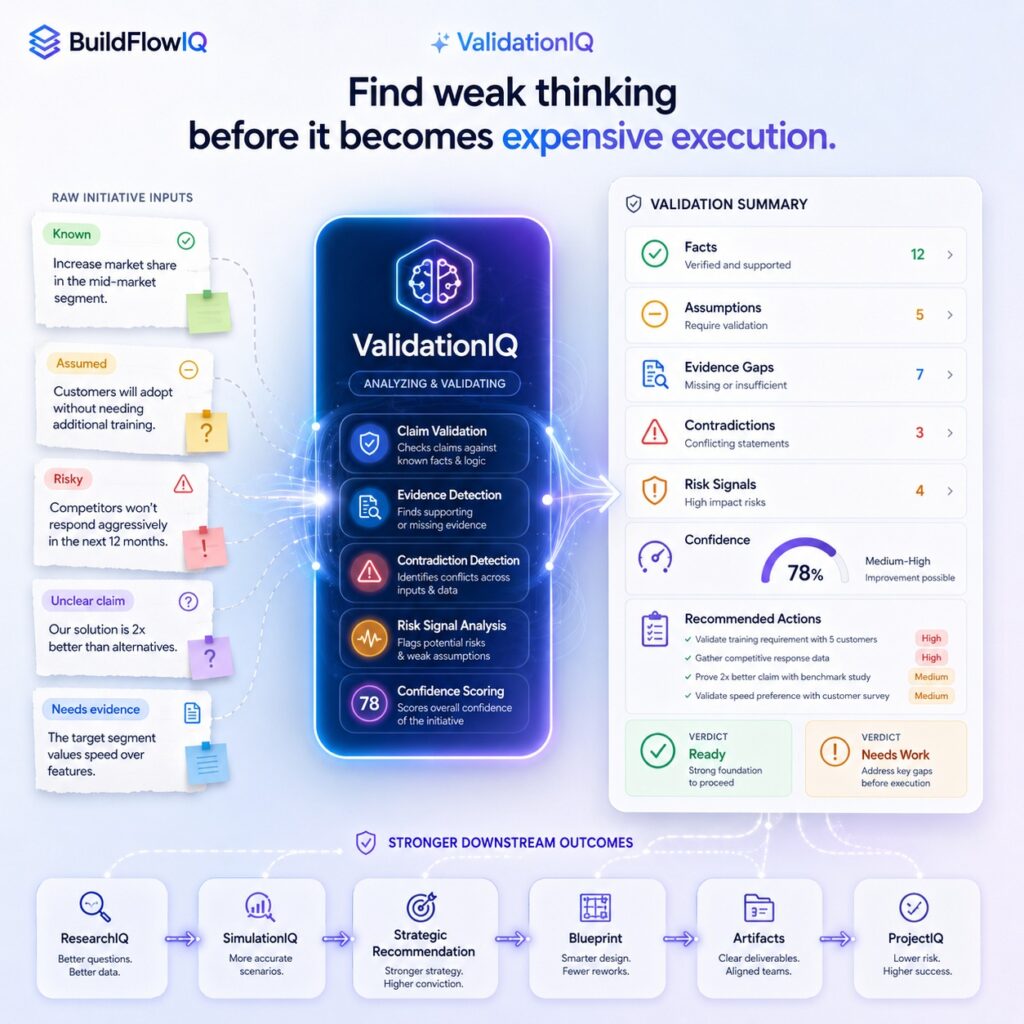
ValidationIQ exists to stop weak inputs from becoming polished but fragile plans.
It helps teams understand what is known, what is assumed, what is risky, what lacks evidence, and where downstream stages should be careful.
ValidationIQ checks the initiative for assumptions, evidence gaps, contradictions, risk signals, validation confidence, blocker signals, and recommended validation actions.
It is both a lifecycle stage and a trust layer that strengthens ResearchIQ, SimulationIQ, Strategic Recommendation, Blueprint, Artifacts, and ProjectIQ.
ValidationIQ helps teams ask: are we building on facts, assumptions, or hope?
ValidationIQ scores, verdicts, and readiness signals are directional planning aids. They help reduce blind spots, but they are not guarantees of business, financial, technical, legal, or delivery outcomes.
Teams often make strategy and requirements decisions without clearly separating facts from assumptions.
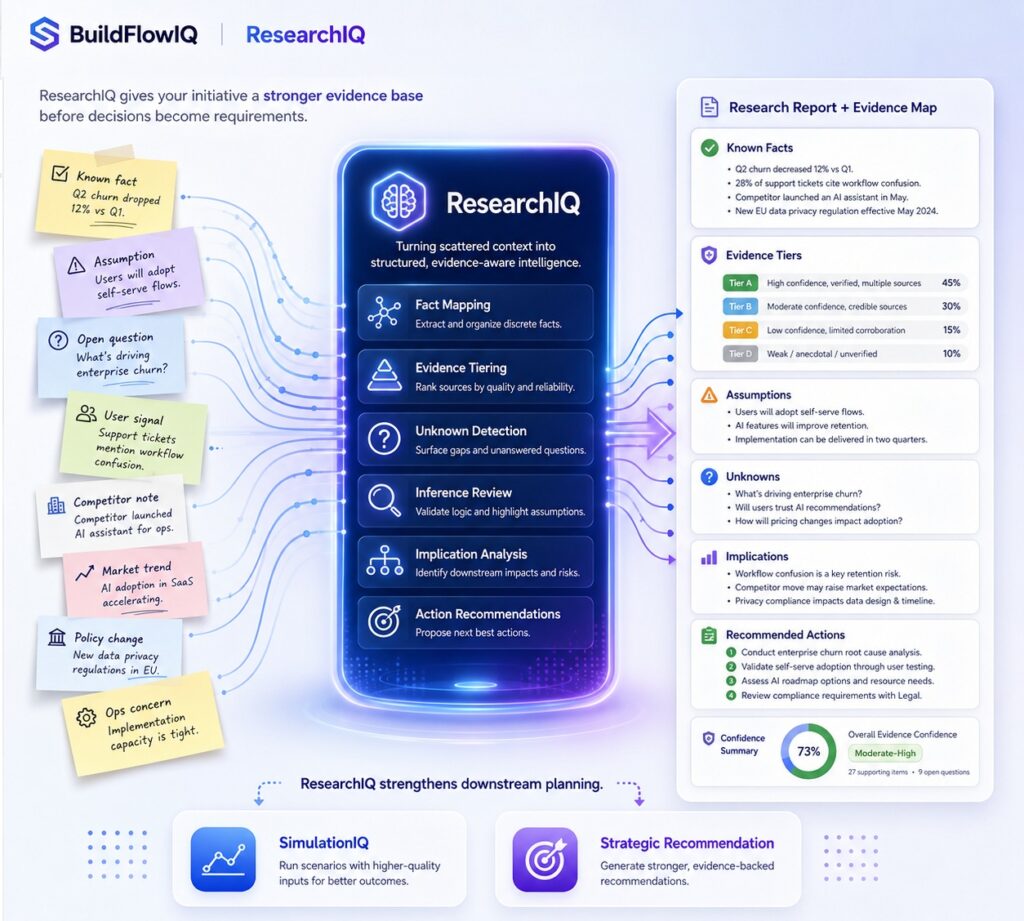
ResearchIQ turns initiative context into structured intelligence. It organizes known facts, evidence tiers, assumptions, inferences, unknowns, implications, and recommended actions.
It adapts to different initiative types, including product, SaaS, HR, policy, marketing, training, operations, internal tools, and technology initiatives.
ResearchIQ gives the team a stronger understanding of the environment before strategy is locked.
ResearchIQ gives your initiative a stronger evidence base before decisions become requirements.
Plans often look good until adoption, timeline, cost, stakeholder, operational, or execution risks appear late.
SimulationIQ helps teams explore possible initiative paths before major resources are committed. It models best-case, expected-case, and worst-case scenarios using qualitative reasoning, early warning signals, failure modes, triggers, and mitigation logic.
It does not pretend to predict the future.
It helps teams think through risk before execution makes those risks expensive.
SimulationIQ does not promise certainty. It gives teams structured scenario reasoning before execution begins.
Too many initiatives move from research to requirements without making a real strategic decision.
Strategic Recommendation helps teams select a direction before the initiative turns into a feature dump, task list, or generic plan.
It recommends a path, compares alternatives, explains tradeoffs, defines decision logic, clarifies go / no-go conditions, and gives the team a sharper way forward.
This is where intelligence becomes direction.
Strategy should guide the Blueprint, not appear after requirements are already written.
Requirements documents often fail because they are created too late, too vaguely, or without enough business context.
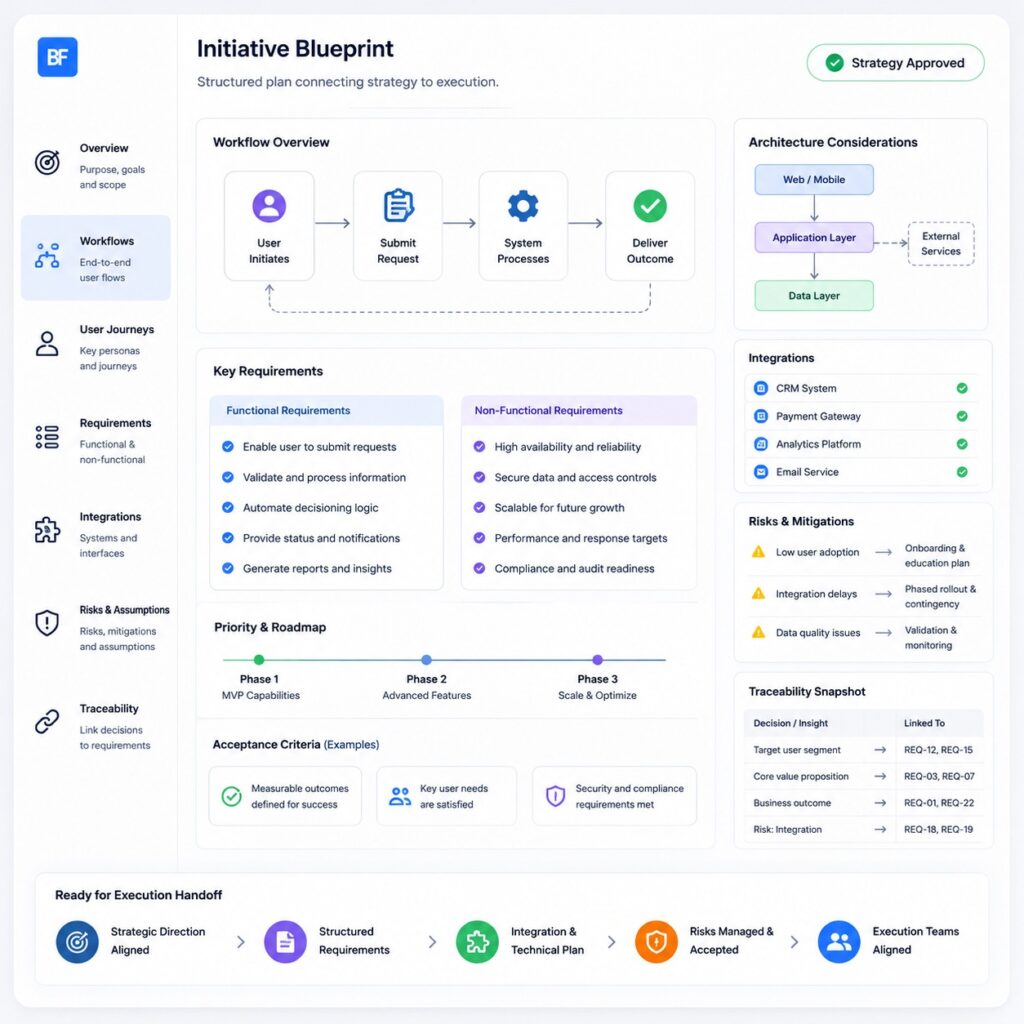
Blueprint is BFIQ’s structured planning artifact. It converts approved intelligence and strategic direction into workflows, requirements, functional and non-functional needs, architecture considerations, integrations, risks, user journeys, priority logic, traceability, and acceptance expectations.
It is designed for both decision makers and execution teams.
Not just a long document. A usable planning foundation.
Blueprint replaces scattered requirements with structured planning intelligence.
A Blueprint is important, but serious initiatives need more than one planning document.
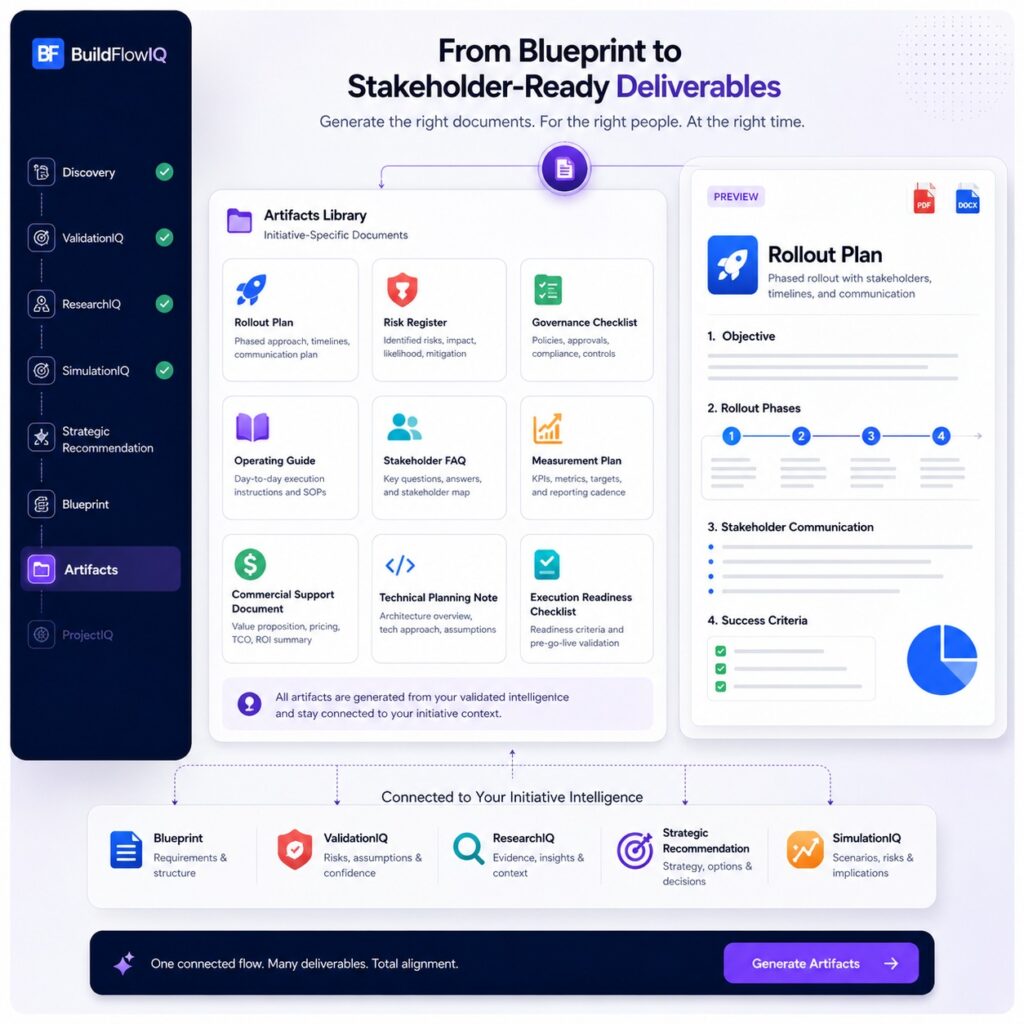
Teams often need rollout plans, risk plans, governance checklists, operating guides, stakeholder FAQs, measurement plans, commercial support documents, technical notes, and execution aids.
Artifacts helps generate initiative-specific supporting deliverables based on upstream intelligence.
Instead of starting every document from scratch, BFIQ creates artifacts tied back to the Blueprint, validation context, research, strategy, and execution needs.
Artifacts turn planning intelligence into stakeholder-ready deliverables.
Execution breaks when approved plans become disconnected tickets, vague task lists, or delivery work with no memory of the original decisions.
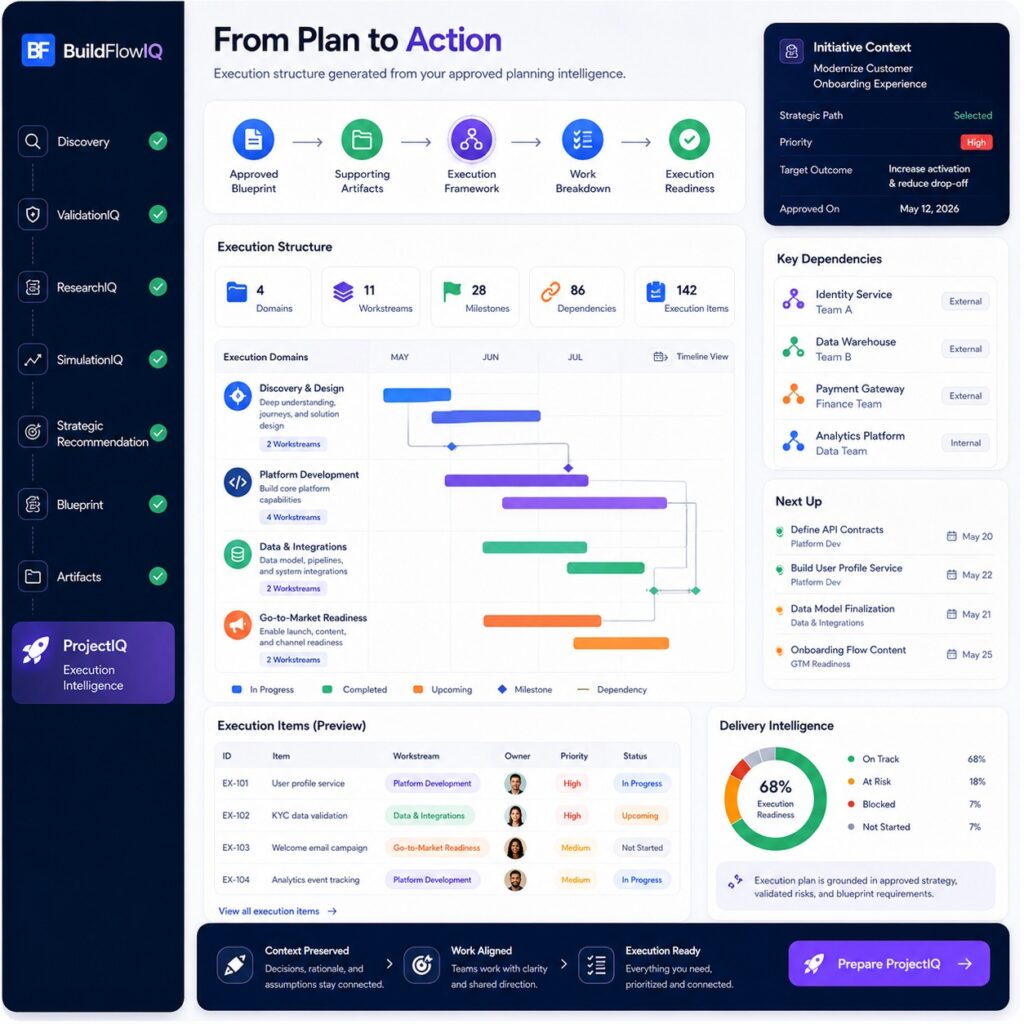
ProjectIQ converts approved planning context into execution domains, workstreams, dependencies, milestones, execution items, and delivery intelligence.
It helps teams move from “we have a plan” to “we know what needs to happen next.”
ProjectIQ is not a generic task board. It is execution intelligence grounded in Discovery, ValidationIQ, ResearchIQ, SimulationIQ, Strategic Recommendation, Blueprint, and Artifacts.
ProjectIQ turns approved planning into execution structure without cutting off the original initiative context.
High-impact planning cannot depend on loose prompts, disappearing chat history, or unreviewed AI output.
BuildFlowIQ is designed for controlled AI planning. Every major output can be reviewed, assessed, improved, versioned, exported, and connected to the initiative lifecycle.
That means your team can inspect the logic, improve the output, understand what changed, and trace how one stage informed the next.
BuildFlowIQ is built for teams that need structured decisions, not just fast text.
Important initiative context, stage outputs, statuses, approvals, and references are preserved as part of the planning chain.
Generated outputs can be assessed for completeness, specificity, actionability, traceability, initiative fit, and execution readiness.
Human review keeps teams in control before generated outputs become active source context for downstream stages.
Regeneration creates new versions, so teams can compare, review, and preserve planning history.
Downstream outputs can stay connected to the approved context that created them.
Planning intelligence can become stakeholder-ready documents and packages instead of staying trapped inside the screen.
Disclaimer : BuildFlowIQ outputs, validation scores, scenarios, readiness signals, and recommendations are planning aids. They improve structured thinking and reduce blind spots, but they are not guarantees of business, legal, technical, financial, or delivery outcomes.
Give leaders structured context for continue, revise, pause, or reject decisions.
Preserve the planning chain from first idea to ProjectIQ execution structure.
Create artifacts based on the initiative’s real context, not a static template list.
Give delivery teams workstreams, milestones, dependencies, and execution items connected to the original why.


BuildFlowIQ is an AI-native Initiative Intelligence Platform that helps teams turn rough business, product, operations, policy, HR, marketing, or technology ideas into structured, reviewable, traceable, and execution-ready planning outputs.

No. BuildFlowIQ generates documents, but its real value is lifecycle continuity. Discovery, ValidationIQ, ResearchIQ, SimulationIQ, Strategic Recommendation, Blueprint, Artifacts, and ProjectIQ work together as one connected planning chain.

ValidationIQ comes after Discovery in the recommended lifecycle and continues to inform downstream stages. It checks assumptions, risks, contradictions, evidence gaps, and validation confidence so later outputs are not blindly built on weak input.

Blueprint is broader than a basic PRD-style document. It connects strategy, workflows, functional requirements, non-functional requirements, risks, traceability, user journeys, priorities, and acceptance expectations into a structured planning artifact.

ProjectIQ is not a generic task board. It prepares execution structure from approved planning context, including workstreams, milestones, dependencies, execution items, and delivery intelligence.

No. BFIQ helps improve planning quality, structure, validation, and execution readiness. Its outputs, scores, scenarios, and recommendations are planning aids, not guarantees.

Before your team commits budget, creates requirements, briefs vendors, launches campaigns, opens tickets, or starts delivery, make sure the initiative is clear enough to deserve execution.
BuildFlowIQ helps you clarify the idea, validate assumptions, research the context, simulate risk, choose strategy, create the Blueprint, generate artifacts, and prepare ProjectIQ execution planning.